
| about us |
about Blanton Collier |
news and events |
team physician's corner |
frank's dawg pound |
character at large |
feedback | contact us |

the Kentucky Pro Football
Hall of Fame
Induction Weekend
and the presentation of
the Blanton Collier Award is
June 22-23, 2023
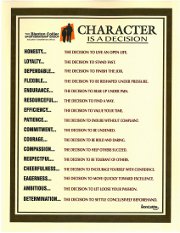



Roll call! Several members of the Board of the BCSG were present at the Lexington Fayette County Police Department Tates Creek Station to present nerf footballs containing character traits for which Coach Collier and the organization stand. Police officers will carry the footballs in their cruisers and give them to kids across the city to encourage positive conversations and interactions. Those organizations who would like to help sponsor this ongoing project may do so for a contribution of $250.

The Blanton Collier Kickoff Classic football game occurred on August 25, 2017 at the Lafayette High School stadium in Lexington, KY. The teams playing were Paul Laurence Dunbar High School, Lexington, KY verses Southwestern High School, Somerset, KY and Lafayette High School, Lexington, KY verses Scott County High School, Georgetown, KY. After the first game was over the Blanton Collier Sportsmanship Group awarded "Character" plaques to one student athlete from each team, as chosen by their coaches. The award reads "for High Achievement, Character and Integrity Both On and Off the Playing Field". The awards went to the following players: Darren Edmond from Dunbar, Patric Edwards from Southwestern, Josh Davis from Scott County and Caylen Williams from Lafayette. The following pictures were taken at the event.
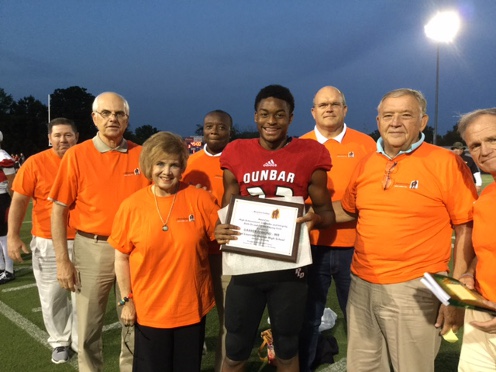
Pictured is a group of the BCSG presenting the Blanton Collier Character Award to Darren Edmond of Paul Laurence Dunbar High School, Lexington, KY
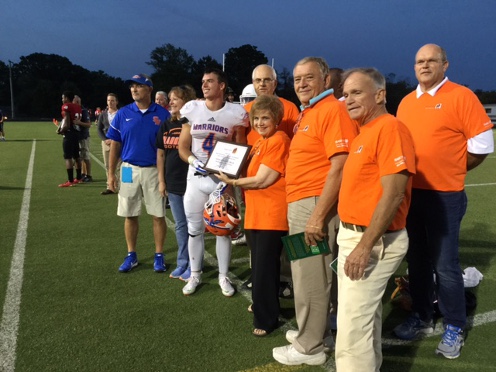
Pictured is a group of the BCSG presenting the Blanton Collier Character Award to Patric Edwards of Southwestern High School, Somerset, KY
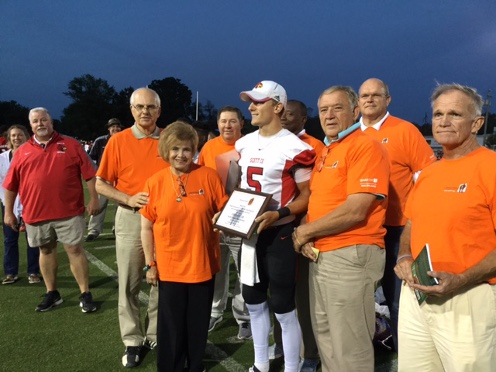
Pictured is a group of the BCSG presenting the Blanton Collier Character Award to Josh Davis of Scott County High School, Georgetown, KY
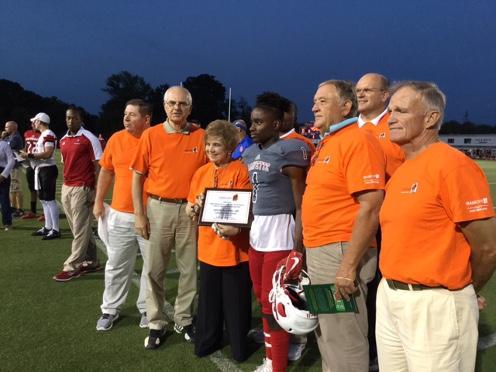
Pictured is a group of the BCSG presenting the Blanton Collier Character Award to Caylen Williams of Lafayette High School, Lexington, KY

Group of the BCSG together with the four winners of the Blanton Collier Character award.
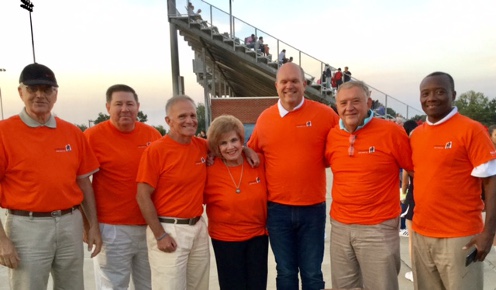
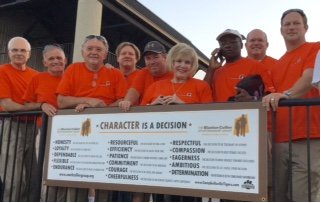
The BCSG directors pictured (L to R) present at the Blanton Collier Kickoff Classic are Scott Brogdon, Scott Crook, Fred Orthmeyer, Kay Collier McLaughlin, Bill Hulette, Ron Butler and Frank Minnifield
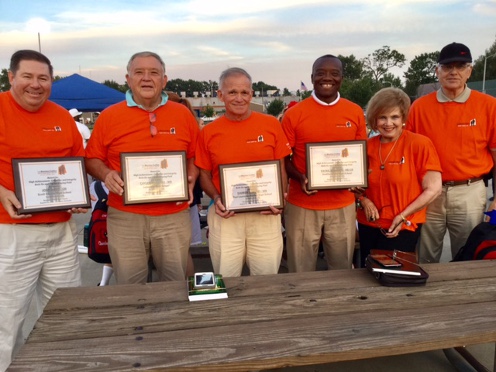
The BCSG Directors
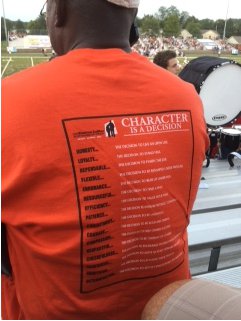
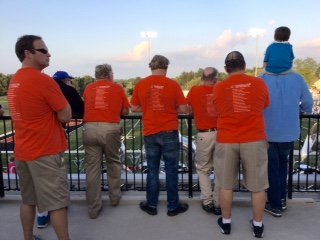
Character Is A Decision
 |  |
 | |
|
BCSG members gathered together on August 19, 2016 at the Georgetown College Toyota Stadium to give Character awards to one player from each team at the Kickoff Classic Double Header between Scott County High School, Georgetown and Tates Creek High School, Lexington and the second game between Lafayette High School, Lexington and Paul Laurence Dunbar High School, Lexington. |
|
Blanton Collier and UK's football legacy
Louisville Courier-Journal
Published: Sunday, August 7, 2016
GARY P. WEST
GUEST CONTRIBUTOR

CJ File Photo. University of Kentucky coach Blanton Collier instructs Billy Mitchell during the season opener against the University of Maryland in 1954. The game was Blanton's debut as UK's coach. |
Who would have thought when the Cleveland Browns won the NFL title back in 1964 that it would be another 52 years before the city would claim another major professional sports championship?
Though it might have seemed like a hundred years to some, it took the Cleveland Cavaliers to rid Cleveland, sometimes called the "mistake on the lake," of the jinx.
When the Browns won Lyndon Johnson was in the White House, and the Rock 'n Roll Hall of Fame hadn't even been thought of, at least not in Cleveland. In fact, many of its inductees were years away from their first performance.
Lost in it all, almost relegated to a footnote, is a Kentucky connection.
Before the Cavaliers win, the Browns were prominent in that they had been the last. Often referred to as "the Jim Brown-led" team, little, if any, has been said of the man who really orchestrated the '64 victory ... Blanton Collier.
Collier was the head coach of the Browns, and he was a Kentucky guy through and through Its history runs so deep that it is important to tell the rest of the story.
Before the Browns, Collier is probably best remembered for coaching the Kentucky Wildcat football team for eight years until he was abruptly fired at the end of the 1961 season, with three years remaining on his $17,500 annual contract.
It is mind boggling in that Collier is the last UK football coach to depart the school with a winning record. His 41-36-3 mark has withstood the multitude of coaches that have followed. Charlie Bradshaw, John Ray, Fran Curci, Jerry Claiborne, Bill Curry, Hal Mumme, Guy Morris, Rich Brooks and Joker Phillips coached there and none had winning records when they left Lexington. So if you think it was a long dry spell in Cleveland, look no further than the 55 years for Kentucky football since Collier left.
Hindsight is easy. But looking back on it makes one wonder what was UK thinking when they fired Collier. In spite of a 5-2-1 record against hated rival Tennessee, he and his staff were often criticized for poor recruiting and lack of enthusiasm. Outside pressure from fans and donors was too much for Collier to overcome.
And now another part of the rest of the story.
Collier had been saddled with several self-imposed recruiting restrictions carried over from the Paul "Bear" Bryant era in the years before.
Bryant, in order to head off any possible future NCAA investigations that had seeped over from the UK basketball scandal, agreed to implement a policy that he would sign no more than five out-of-state players annually.
It gets even crazier. An added stipulation was that the five had to seek out UK and then apply for scholarships.
Bryant's teams had been rich with kids from Pennsylvania and Ohio, but as they graduated, the coach realized that he was now operating at a disadvantage ... one he had helped bring on himself. Leading his Kentucky to bowl games on a regular basis, he now saw a dim future for the Wildcats.
Bryant said hello to Texas A & M, and Blanton Collier said hello to Lexington.
Collier, now with all of Bryant's baggage that included no out-of-state recruiting contacts, increased academic requirements, and a UK administration that was opposed to "redshirting," (a practice that allowed holding athletes out of participation for a year without affecting their eligibility) faced an uphill struggle in the SEC. All of this was happening in a state with just a few more than a hundred high schools playing 11-man football. By comparison, Tennessee had more than 300.
Although Kentucky went to no bowl games under Collier, compared to Bryant's record he was written off as underachieving. Still, he managed an SEC Coach of the Year honor in 1954, with a 7-3 record. But, there was one honor he won in 1959 that may never be duplicated. After losing to LSU 9-0 in 1959 he was named SEC Coach of the Week. His Wildcats held All-American Billy Cannon to 11 yards rushing. This would be a great trivia question.
By today's standards Collier's teams would have played in several bowls, but during those years there were only six or seven that drew any interest at all. Today there must be at least a hundred, even to the point of considering teams with losing records.
But not then.
Collier at Kentucky had assembled a coaching staff that would later become a "Who's Who" in the profession: Of the eight, including Collier, all went on to success in the NFL, five of them becoming head coaches. Ed Rutledge became a scout; Howard Schnellenberger, Baltimore Colts; Ermal Allen, assistant Dallas Cowboys; Don Shula, Colts; John North head coach New Orleans Saints; Bob Cumings, assistant Saints; Bill Arnsparger, head coach New York Giants; and Chuck Knox, head coach Los Angeles Rams and NFL Coach of the Year his first season.
Two weeks after Collier was fired he was hired by legendary Paul Brown to be his top assistant in Cleveland. Two years later he had become the head coach, and in 1964, while still being paid by the University of Kentucky, he led theBrowns to the NFL title. Just as he had done at Kentucky, he coached eight years in Cleveland leaving with a sterling 76-34-2 record.
Collier paid his dues in the coaching profession. After graduating from Georgetown College he returned to his hometown and began a coaching career at Paris High school in 1924, first in basketball, where he compiled a 373-141 record and four trips to State Tournament over 20 years. His 16 years of football coaching led to an overall record of 73-50-10.
In 1944, Collier joined the Navy at the age of 37 because it was the patriotic thing to do. With football team rosters depleted by the war effort, the only coaching job he left behind was basketball.
Paris resident Betsy Kuster recalled that her dad, Eddie Reynolds took over the basketball team.
"My daddy worked in a nearby school system, but agreed to comeover to Paris and coach basketball when Blanton left," she said. "Everyone in town knew he’d come back when the war was over, but he didn't."
It was at the Great Lakes Naval Training Center near Chicago that he met Paul Brown for the first time. Two years later when Brown was hired to jump start the Cleveland Browns in pro football, he brought Collier along as his assistant.
From 1946 to 1953, Collier was a big part of the team's success as it won the NFL title in 1950, and lost in the championship games the following three years.
Collier was given much credit for the development of Hall of Fame quarterback Otto Graham, as well as creating a player grading system that is still used in part today.
So when Bear Bryant departed, UK didn't have to look far to find his replacement.
Collier's successes were well known, and on occasion he would do some scouting for Adolph Rupp's basketballteam. There were even someclosed-door discussions that Collier's name was in the mix to replace Rupp, should he not be able to survive the scandal that cast a dark shadow on the program in the late '40s and early '50s.
During his eight years, Collier coached several All-Americans including Steve Meilinger, Howard Schnellenberger, Lou Michaels, Irv Goode and Calvin Bird.
As memories fade with each passing day -- coaches and players are now microwaved at such a breakneck speed -- it's difficult to latch on to what they are about. Collier's major successes came through football, and his achievements as a basketball coach have almost been lost.
To further show that Collier's basketball coaching history had slipped through the cracks, former UK basketball coach Joe B. Hall said he had no idea Blanton coached basketball.
"I had never heard of it before now," Hall recently said. "His record at Paris shows he must have been a heck of a coach."
Roy Kidd, the former hall of fame football coach at Eastern KentuckyUniversity, also didn't know of Collier's basketball coaching success.
"When I was a high school football coach in Richmond I'd go over to Lexington for some of his clinics," Kidd recalled. "He always found time for me even one-on-one. He'd draw up some plays on the blackboard for me. Coach Collier always seemed to share his time."
Blanton Collier's name and what he accomplished is very much relevant today. His memory should not be lost, and to make sure it's not, look no further than the record books in Kentucky prep coaching, UK football, and the NFL Cleveland Browns. It was awhile back, but Collier made sure in 1964 that Cleveland rocked.
Collier died in March 1983 at the age of 76. He and close friend Bill Arnsparger, another Paris native and former NFL head coach, are buried in Paris.
There's no excuse. Get up, get out, and get going!
Gary P. West is a Kentucky freelance writer. He can be reached at west1488@twc.com.
Kentucky Pro Football Hall of Fame – The Blanton Collier Sportsmanship Group June 25 & 26, 2015
Football in June, what could be better! Each year after attending the Kentucky Pro Football Hall of Fame and Blanton Collier Award for Integrity On and Off the Field in Louisville on Thursday & Friday (June 25/26-2015), I'm struck by the comradery of the players, coaches, spouses and friends relatives of this group. The group also includes the Kosair Children's Hospital and the network of Brave Hearts.
This year's Ring Ceremony was back at Churchill and the track was running. After the reception we met to provide the introduction of the new 2015 Inductees, hear about the mission of the Blanton Collier Sportsmanship Group (BCSG) and the ceremonial assemblage for a group photo of the past inductees and the class of 2015. Gil Mains was represented by his son Gil Manis, Jr., along with Inductees Aaron Jones and Jacob Tamme the stage was not ready until Doug Buffone's widow Dana made it to center stage. We all felt a deep since of shared loss with Dana as Doug was very excited about attending the event and his passing on April 20, 2015 is a loss of a fine man.
In my remarks about the BCSG it was a pleasure to have our first ever recipient in 2007 in the audience - Rich Brooks. Rich was in attendance to induct his star player Jacob Tamme. Over the years the BCSG has inducted respected players, coaching families, football families and Blanton's last recruiting class. This year brought to the stage Nick Saban, truly a man of integrity, dedication and hard work. In his remarks accepting the award he gave credit to all those that are integral to achieving success. But he highlighted that the need to help others is central to one's personal accomplishment in life. As he noted, when you pray do you do it for a blessing or the blessing to help someone less fortunate? Nick encouraged those in attendance to seek the later. And it shows in Nick Saban's life and civic involvement that he is true to helping children in need through his Nick's Kids Charity. So it was especially fitting as he made his way out of the Brown Theater that he was able to be photographed with the Children on hand from the Kosair Children's Hospital. To know the work of this organization as they treat those affected by congenital heart disease is to know the Brave Hearts are an organization that is truly worthy of one's charitable giving. Or as Nick would say: "People don't care what you know, until they know you care."

Nick with children representing Kosair Children’s Hospital |
Events that celebrate the accomplishments of one athletic career can be special on so many levels. To hear Gil Manis, Jr. offers his appreciation to the Kentucky Pro Football Hall of Fame for inducting his father who had a remarkable career with the Detroit Lions it is unmistakable to know that this honor was a special event for his family. The video highlights from his career were a testament to the heart and drive of this Murray State University graduate. Aaron Jones is an individual who overcame a difficult period in his youth. His appreciation for his high school coach who gave him a steady dose of tough love to this days fuels Aaron's noteworthy involvement in youth activities. Jacob Tamme was a favorite target of Peyton Manning both with the Indianapolis Colts and the Denver Broncos. Coach Rich Brooks in his induction remarks emphasized that Jacob was one player you never had to worry about doing the right thing. A man of impressive character, Jacob continues to make a positive impact on his community. Doug Buffone is a player that was universally admired for his play on the field and many would account his fun nature approach off the field made him an individual that was loved and admired by all who had the pleasure to know him. He played alongside Dick Butkus with the Chicago Bears. With Otis Wilson gracefully standing with Dana, and his daughter eloquently concluding her mom's remarks about Doug we could all appreciate the lasting impact he has made in the world.
Those that play football in the National Football League are easily categorized with statistics of their performance each Sunday. They have legions of fans during their playing days and represent a team and a city during that time. However, getting to know these players at the Kentucky Pro Football Hall of Fame event brings into focus the journey these players and that of their families. The highlight films punctuated with comments from their inductor speak to the deeper aspect of their drive and determination. The acceptance speeches allow us all to share in their accomplishment and we are all enriched knowing the deeper story of the career of professional athletes that hold dear to their connection to Kentucky.
Kosair Children's Hospital is Kentucky and Southern Indiana's only free standing, full-service pediatric care facility dedicated exclusively to caring for children, regardless of a family's ability to pay. It is through the generosity of the community that Kosair Children's Hospital is able to provide for the physical and emotional health of children – and when they need it.
Learn more at HelpKosairChildrensHospital.com
Dave Gyor
President and Chairman
Blanton Collier Sportsmanship Group
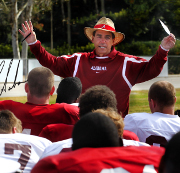
Nick Saban is coming to Louisville, KY on June 26, 2015.
Keep the date available and use the link on this website page to purchase tickets. The Blanton Collier Award for integrity both on and off the field will be presented to Nick Saban as part of the KY Pro Football Hall of Fame induction ceremony at the Brown Theater in Louisville, KY on June 26, 2015.
Purchase tickets at the following link:
Ky Pro Football Hall of Fame
Youth Football and the Brain
CNN
Published: February 4, 2011
"Bull in the ring" is a drill almost as old as football."
Several members of the team form a ring around a single player. The player in the middle begins a nervous shuffle, eyes darting, arms tense, as his teammates, one at a time, fling their bodies toward him at full force. He is the target of tackle after tackle, and if he moves too slowly the hits can be punishing.
For many coaches, "bull in the ring" is an exercise in agility and mental fortitude. Others consider it violent. ...Click here for the article.
Basketball Coach Accused of Whipping Players
CNN
Published: November 11, 2010
A Jackson, Mississippi, high school basketball coach is accused of whipping students for "failing to run basketball plays correctly," according to a federal lawsuit filed this week by three students.
Coach Marlon Dorsey acknowledged he "paddled" students, but he defended it as a way to "save these young men from the destruction of self," the court filing said.
A school district spokeswoman would not confirm whether Dorsey has been suspended, but he has not shown up to teach or coach at Murrah High School in recent days, according to the students' lawyer. The suspension was apparently for 28 days without pay, attorney Lisa Ross said.
Dorsey is still employed with the district, spokeswoman Peggy Hampton said late Thursday afternoon.
The students are still attending classes and are playing on the boy's varsity basketball team, Ross said.
One senior was whipped "daily and sometimes more than once daily by striking him three times across his buttocks each time" with a "five to ten pound weight belt," the suit said.
One beating was captured on video, the suit said...Click here for the article.
House committee hears testimony
Washington, DC - The Associated Press
Published: September 23, 2010
Doctors told lawmakers Thursday that student-athletes risk altered lives and permanent brain damage if schools don't protect them from the effects of blows to the head.
A House committee grappling with how best to safeguard young athletes also heard from an NFL player who recently retired because of post-concussion problems; a mother whose son, a University of Pennsylvania football player with brain damage, committed suicide; and a high school girl unable to keep up with her classes since suffering a concussion on the soccer field... Click here for the article.
Hall-of-Famer Brown not surprised by rise of concussions in NFL
Santa Clara, Calif.- The Associated Press
Published: September 16, 2010
Jim Brown isn't surprised by the rise in diagnosed concussions among NFL players and says the league and the union need to do more to protect those players... Click here for the article.
Texas high school QB dies after collapsing on sideline
By Jim Halley, USA TODAY
Published: September 19, 2010
West Orange Stark (Orange, Texas) senior quarterback Reggie Garrett, 17, whose family said he had a history of seizures, collapsed on the sideline Friday after throwing a touchdown pass and later died at Memorial Hermann Baptist Hospital in Orange. An autopsy is planned. His team went on to defeat Jasper, Texas, 27-7. Garrett's death was the second last week involving a high school football player. Chickasha, Okla., canceled its game Friday with Noble, Okla., after Chickasha junior offensive lineman Kody Turner, 16, died earlier in the day. He had collapsed in practice Tuesday and been in intensive care at the University of Oklahoma Hospital... Click here for the article.
Max Gilpin School Football Death Suit Settles
By Jason Beahm, blogs.findlaw.com
Published: September 17, 2010
Jefferson County Public Schools have settled with the parents of a 15 year-old Louisville, Kentucky boy who died of heat stroke at a high school football practice. The insurers will pay $1.75 million to the parents of Max Gilpin, who died three days after suffering severe heat stroke at a Pleasure Ridge High School football practice in 2008... Click here for the article.
More Concussions Treated in Basketball Players
By Todd Neale, Staff Writer, MedPage Today
Published: September 13, 2010
Although basketball-related injuries treated in the emergency department have decreased among children and teens in recent years, the number of traumatic brain injuries (TBIs) has increased, researchers found... Click here for the article.
The 2010 NFLPA, Kentucky Chapter Blanton Collier Award
JIM BROWN RECEIVED NFL/COLLIER AWARD ON JUNE 18, 2010
Jim Brown, the Hall of Fame record setting running back for the 1964 World Champion Cleveland Browns, and Founder of the Amer-I-Can Foundation to assist young people who might otherwise fall through society's cracks came to Lexington to receive the Kentucky Chapter NFL Hall of Fame BLANTON COLLIER AWARD for giving back with integrity off the field as well as on. The BLANTON COLLIER SPORTSMANSHIP GROUP, a non-profit established to promote ethics, education and excellence in athletics joined with the KY Chapter NFL in the presentation of the award and other activities during Brown's visit to Lexington. Click here for the article.
Retired MLB pitcher Curt Schilling's article on coaches win if they make their players better people
April 19, 2010
The following is a link to an USA Today article on how coaches win if they make their players better people. Click here for the article.
Cincinnati Bell News Story: NFL combine puts more emphasis on concussions
February 27, 2010
The following is a link to an AP article discussing progress in the NFL concerning concussions. Click here for the article.
Oregon's troubles are traceable to 'the punch'
February 24, 2010
The following is a link to an article discussing the negative signal that may be given to a team when there are no proper consequences for an athlete's actions.
Oregon's troubles are traceable to 'the punch' Opinion: Six months later, the punch still is reverberating - through a suddenly controversial offseason, through public perception about a string of recent arrests, through the entire Oregon football program. Click here for the article.
Recent Articles on Head Injuries & Football
February 16, 2010
The following are links to three interesting articles concerning repetitive football injuries and what may be done to help eliminate them.
- Time Magazine article 'The Problem with Football: How to Make It Safer'. Click here for the article.
- Time Magazine article 'Texas Football and the Price of Paralysis'. Click here for the article.
- AP article 'Concussion Awareness Grabbing Hold Across the NFL'. Click here for the article.
By Billy Reed January 11, 2010
I'm a founding board member of the Blanton Collier Sportsmanship Group, an organization designed to promote coaching excellence and deplore coaching excess by stressing the principles of the late Cleveland Browns and University of Kentucky football coach.
Collier was both a gentleman and a gentle man - the Tony Dungy of his day. His methods were completely different from the likes of Paul "Bear" Bryant, Woody Hayes, and other coaching icons of the time. He spoke softly, never cursed, and treated his players like human beings at all times.
But because he didn't win as Bryant had, Collier was fired by UK in 1962 and replaced by Bryant disciple Charlie Bradshaw, who instituted a reign of terror and abuse that even his mentor probably would disavow. He ran off many of Collier's recruits, most of whom were excellent football players.
The physical and mental torture exacted by Bradshaw and his assistants left scars that are still visible today. In fact, it was a cathartic reunion of the Bradshaw victims that led to the book, "The Thin Thirty," and the founding of the Blanton Collier Sportsmanship Group.
After leaving UK, Collier replaced his mentor, Paul Brown, as head coach of the NFL's Cleveland Browns. In 1964, the Browns won the NFL championship with a team built around Jim Brown, the greatest running back in pro history. To a man, the Browns players loved their quiet, scholarly coach.
It is the purpose of our group, first and foremost, to promote the ideals for which Collier stood - education, excellence, and integrity. And I want to make it crystal-clear that we are not anti-coach by any means. We are not about punishment as much as we are about enlightenment.
If you don't think there's a need for a group like ours, consider some startling recent developments:
- Mike Mansion resigned at Kansas amid charges that he mistreated his players. He was voted coach of the year by multiple media outlets in 2007 after guiding the Jayhawks to a 12-1 record and an Orange Bowl victory.
- Mike Leach got fired at Texas Tech for reportedly ordering that player Adam James, son of ESPN analyst and former SMU star Craig James, be locked up in a dark place after suffering a concussion. Even at Guantanamo Bay, this would be cruel and unusual punishment.
- South Florida fired Jim Leavitt, who had just completed the second season of a seven-year, $12.6 million contract, after a school investigation concluded that he grabbed one of his players by the throat, slapped him in the face, and then lied about it.
If the Leavitt case sounds familiar, it's because the charges against him are roughly the same as those lodged against basketball coach Bob Knight in the Neil Reed case. Knight was not fired at the time, but that incident proved to be the beginning of the end for him.
Oh, yeah. Florida State finally forced out Bobby Bowden, a serial cheater, years after it should have. On the way out at Notre Dame, Charlie Weis threw Southern Cal's Pete Carroll under the bus, implying that he had engaged in an affair with a student.
I'm sure if I keep thinking, I can come up with other examples of coaches behaving badly. This isn't new, but the culture in American society is. It is clear that educators and parents no longer will tolerate abusive behavior from coaches, no matter how successful they are.
It can only be hoped that the message trickles down to the high-school level, middle-school, and playground levels. For years, far too many coaches have been guilty of trying to imitate the big-name guys they see on TV all the time - especially the ones who do the most ranting and raving.
No telling how many young psyches and bodies have been bruised by some ill-prepared Woody Hayes or Vince Lombardi wannabe. You know the type I'm talking about. Every Little League and Junior Pro League in the nation has a few of them. They are a pox on our society.
Fortunately, the bad coaches are a minority that's gradually being exposed and eliminated. Today's aspiring coaches are emulating the likes of Dungy, Urban Meyer, Nick Sabin, Rich Brooks and others who are much closer to Collier philosophically than to the raging taskmasters who have been glamorized by countless books and movies.
A book and made-for-TV movie about Bryant, "The Junction Boys," illustrated just how abusive the Bear was in his younger days. It's interesting to wonder how many young coaches watched the movie and then tried to adopt Bryant's methods. Hell, don't give those boys any water. The Bear didn't do it and I'm not, either.
If you are interested in supporting positive coaching methods and eliminating bad ones, if your son or daughter is suffering under a Jim Leavitt or Mike Leach on training wheels, you might want to check out the Blanton Collier Sportsmanship Group's website, www.CoachCollierGroup.org
Our address is P.O. Box 4052, Midway, Ky., 40347.
Hall of Fame sportswriter joins NSJC
Indiana University School of Journalism Web Report - August 12, 2009
The following press release concerning our Director Billy Reed was released by the Indiana University's School of Journalism.
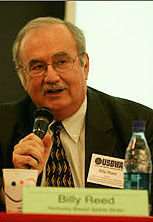
Sportswriter William F. "Billy" Reed brings 50 years of experience to his new post at the IU National Sports Journalism Center. He visited IU in 2006 as a panelist at a sportswriting workshop.
William F."Billy" Reed, a former senior writer for Sports Illustrated and a national hall of fame sportswriter and author, will teach at Indiana University's National Sports Journalism Center this fall.
Reed will teach two courses as an adjunct faculty member at the center located at the IU School of Journalism at IUPUI.
"As I pass the 50th anniversary of my career in journalism, I'm thrilled to have this opportunity to work with the sports journalists of the future," Reed said. "The craft I love is changing, not dying, and it's comforting to know that by establishing this center, IU is embracing the challenges of change in a positive and exciting way."
Tim Franklin, the center's director and the Louis A. Weil, Jr. Endowed Chair at the School of Journalism, said Reed is a nationally accomplished sports writer who will inspire students to be the best in the industry.
"Billy Reed is exactly the kind of instructor one expects in America's premier sports journalism center," said Franklin, former editor of The Baltimore Sun who joined IU in January. "He has covered many of the biggest sports stories in the world over the course of his illustrious career, and he's done it for a magazine tha t is the gold standard for outstanding sports writing. He also brings a passion to teach and help students prepare for a career in sports media. We're thrilled to have someone with his credentials in our program."
Reed is as member of the U.S. Basketball Writers Hall of Fame, the Kentucky Journalism Hall of Fame and the Kentucky Athletic Hall of Fame. He has won National Headliner Awards for investigative reporting and sports columns and a national Sigma Delta Chi Award for general reporting. He has been named Kentucky Sports Writer of the Year eight times.
"Impressive as his achievements are, they run a distant second to his passion for the practice of the craft," said Dave Kindred, a former long-time sports columnist for The Washington Post and an NSJC advisory board member. He also is a member of the National Sportscasters and Sportswriters Hall of Fame and is a winner of the Red Smith Award for lifetime achievement in sports journalism. "He believes the unchanging fundamentals of journalism are the foundation of storytelling that works anywhere anytime."
Reed worked two stints at Sports Illustrated for a total of 29 years, the last 10 of which he had the title senior writer. Reed also was sports editor and columnist for the (Louisville) Courier-Journal from 1977 to 1986. He later was a sports columnist for the (Lexington, Ky.) Herald-Leader. He has authored or contributed to 14 books. In recent years, he has been a public relations e xecutive for the State of Kentucky in various capacities.
In the fall semester, Reed will two teach sports journalism courses: J154 Introduction to Sports Journalism: Controversy, Conflict and Characters, and J152 Introduction to Sports Media in Society. Those classes will be based at the IUPUI campus in Indianapolis, but also offered via videoconference to students in Bloomington. They are two of the four courses being offered to students this fall as part of the NSJC's new curriculum.
Minnifield Honored
LOUISVILLE, Ky. July 23, 2009 -- Frank Minnifield, a founding board member of the Blanton Collier Sportsmanship Group, Inc. was one of four former players honored at the Governor's Cup festivities kicking off the countdown to the Kentucky-Louisville football game on Sept. 19 in Commonwealth Stadium. The winning team receives the Governor's Cup, sponsored by Kroger's.
Minnifield was an outstanding defensive back and kick returner at Louisville in the late 1970s. Although he wasn't a high draft pick, he became an All-Pro cornerback for the Cleveland Browns and, with teammate Hanford Dixon, founded the "Dawg Pound," which has become an institution at Browns' home games. After making a good play, Minnifield and Dixon would bark at each other like dogs, a practice that quickly was adopted by fans in the end zone.
Naturally, then, Minnifield was greeted with barks when he was introduced at the Governor's Cup dinner and silent auction on July 22 at the Henry Clay in Louisville. More barking ensued the next day when he was introduced again at the luncheon and press conference built around head coaches Rich Brooks of Kentucky, a member of the BCSG advisory board, and Steve Kragthorpe of Louisville.
"This is a great honor and I appreciate it very much," said Minnifield, a graduate of Henry Clay High School in Lexington. "Coach Fran Curci didn't recruit me at Kentucky so I had to walk on at Louisville. But things worked out pretty well and I'm grateful for the opportunity to play football both in college and the NFL.
Minnifield and John Madyea, a quarterback for the Cards and then-coach Lee Corso in the early 1970s, were this year's Louisville honorees. The Kentucky honorees were Bob Hardy, who quarterbacked the Wildcats to three consecutive wins over Tennessee in the 1950s, and Joe Federspiel, an all-Southeastern Conference linebacker in 1970 who went on to a stellar NFL career with the New Orleans Saints.
All proceeds from the Governor's Cup festivities -- dinner, silent auction, media luncheon, and golf scramble -- go to Visually Impaired Preschool Services, an organization that helps young children who have vision problems.
After his retirement from the NFL, Minnifield returned to Lexington and launched a successful business career. He's a member of the Kentucky Chapter of the NFL Hall of Fame and the U of L board of directors.
The 2009 NFLPA, Kentucky Chapter Blanton Collier Award
The Recipient Of The 2009 NFLPA, Kentucky Chapter Blanton Collier Award - Coach Tony Dungy!
Coach Tony Dungy, retired head coach of the Indianapolis Colts and the Tampa Bay Bucaneers has been named the recipient of the 2009 NFLPA- Kentucky Chapter's 3rd Annual Blanton Collier Award for INTEGRITY ON AND OFF THE FIELD. He was presented the award at the 7th annual Kentucky Chapter NFL Hall of Fame Ceremony on Friday evening, June 19th, at the Opera House in Lexington, Kentucky.
Most Caring Coach
Picked from 1,503 nominees to USA Weekend, three mentors stood tall.
By Allyson Dickman, Vicki Kriz and Adaora Otiji USA Weekend 5/29/09-5/31/09
FOR THE 17th year, readers nominated outstanding youth coaches who inspire their young charges. Our judges chose three winners from 10 finalists. Each receives $1,000 and will be honored this summer by the World Sports Humanitarian Hall of Fame. One of the three finalists is coach Danny Carothers from Bowling Green, KY.
Helping boys keep their eyes on the ball and on what's important
Danny Carothers, 48, has found concrete ways to support the 10- to-12-year old boys he coaches on the west side of Bowling Green, where youth football is more than an outlet. Many of Carothers' players have no male role model, and some come from homes where poverty, drugs and abuse are present.
"Carothers believes the anger and aggressiveness the players take out on the field begins at home," says nominator Elizabeth Lauer.
Off the field, the father of six treats the boys to outings like skating and high school football games, meals and hanging out at his house with his 12-year-old son. He invites community leaders - policemen, doctors, teachers and former players - to talk to his boys. "The older kids see they are important as role models, and the younger kids see what they can achieve," says Ron Whitlock. Carothers, Whitlock and and four other men also helped start West Side Camp, a summer enrichment program held on Whitlock's farm for boys on and off the team. "He wholeheartedly gives of himself," says team mom Judy Burnam. "It's him seeing a need and not wanting these kids to fall short and not fall into the wrong hands."
Carothers is a long-term figure in his players' lives. "Their motto is 'Once a Bear, always a Bear,' " says Roger LaPoint, whose son played for Carothers. "Danny's their surrogate father - they want to share their accomplishments with him - and he's there to support them."
"Danny was my role model as a kid," adds former Bear Jared Carpenter, now at Northwestern University. "He was the man who made the game fun. We played hard for him because you never knew when he would come get you and take you out for ice cream. When I grew up, he kept me confident, always complimenting me and always watching me play even though he wasn't coaching me. He became more of a mentor for me and one of my biggest fans."
More important, he keeps the boys active in their community. The Bears regularly visit residents at a local nursing home and distribute Thanksgiving turkeys to neighbors. One year, the boys met an old friend of Carothers who was raising her two grandchildren while battling cancer. With a little encouragement from their coach, the players brought that family a Christmas dinner and gifts, and some of the boys gave the family $5 of their own allowance.
Carothers has taken players in and has them over on weekends. And when a player needs anything - from a coat to a hot meal - the coach is there to provide it, either from his own pocket or gathered help from the community.
To Carothers, the wins on the field don't matter. His greatest joy comes from simply being with his young men. "I get to interact with these kids - it gives me a chance to be very close to them," Carothers says. "It's all about knowing that you've got them around you for a couple of hours every week."
Let's Stop Tolerating All Abusive Coaches
By Mike Giuliano - April 10, 2005
Dr. Mike Giuliano was the women's soccer coach at San Diego State at the time of this article.
He yelled profanities at our kids. He called them names. He became a serious challenge to the development of their self-esteem. He was spiteful toward them. He was downright mean to them.
And we paid him many thousands of dollars to do all of this to our sons and daughters.
I know, scores of columnists and talk-show hosts have lamented the sorry state of youth coaching in our society. They scare us with stories of abuse, both physical and mental, all in the name of winning. And yet, every week, I hear and see score and scores of atrocities that don't make it on the talk-show circuit.
As a Division I collegiate soccer coach, much of my time is spent patrolling the sidelines in search of the next Mia Hamm. Add to that many more hours I spend cheering on my three kids as they play their various sports of choice. I see lots of youth coaching, from the AYSO volunteer parent-coach to the club coach making nearly six figures to run a nationally ranked program. And at all of those levels, I still cannot believe what I see and hear: 10-year-old boys being screamed at by red-faced volunteer coaches, and 18-year-old girls being called the vilest of things, simply because they are not playing up to the standards of their coach.
Last summer I attended a high-powered club tournament in the East. I had the unfortunate opportunity to witness a coach in the middle of a halftime meltdown. With sweat streaming down his face, he proceeded to direct a profanity-laced assault at almost every player on the team. To win this tournament meant scholarships for all of them to major colleges, he screamed, adding that their uninspired play was sure to sicken the recruiters, just as it sickened him. On and on he went, and yet the parents of the players sat nearby through it all, straining to hear with one ear while exchanging chatter about the latest community gossip with the other.
One of those parents was in my office a few weeks later, explaining to me why his daughter was truly Mia II. The subject of his daughter's club coach came up.
"Yeah, the guy is certifiably insane," he began. "But, hey, he makes them into winners. Before he came, they hadn't won the league title in over five years!" The father didn't scream at his child (at least not that I knew of). The father didn't belittle her ability or her weight or her lack of heart in front of her friends. The father didn't find the most sarcastic ways possible to tell her how she was ruining it all for her teammates. But he paid another man handsomely to do it instead.
It is not getting better, and, in my view, in many circles it is getting worse.
At the high school level, there is so much concern over the price of college that any coach who may increase our children's chances of securing an athletic scholarship is treated with reverence, regardless of his or her demeanor. It is often worse at the college level, for the financial stakes are even higher for the institution. And, sadly, it is often just as bad at the youth level.
The outcome of all of this has been well-documented in scores of studies of childhood development. These kids are more likely to develop serious self-esteem problems. These kids are more likely to marry abusive spouses. These kids are more likely to abuse their own spouses, for they have learned that verbal abuse unleashed for a "good cause" is justified.
We wouldn't let classroom teachers talk to our kids this way. We may not even let parents publicly treat their own kids this way. And yet, our pragmatically driven approach to youth sports causes us to turn a deaf ear and a blind eye when such behavior is accompanied with on-field success.
The youth/collegiate sports community must come to embrace three truths:
1) While fear and intimidation can motivate us, the negative by-products of such behavior far outweigh the advantages.
2) What our kids learn in the arena of sport, they will practice in society.
3) It doesn't have to be this way. At every level of sport, there are great examples of coaches who motivate and teach their athletes with compassion instead of anger. They teach us that winning and learning and fun and respect and dignity can all play in the same orchestra, often with stunning results.
But if we can't change youth sports culture overnight, we can at least change the future of our own children. Never, ever let your child play for a coach who has forgotten that at the end of the day, it is still just a game. Never, ever let your child be taught that verbal harassment has a useful purpose in society. If we just rescue one child at a time, perhaps one day the abusive coach will end up with no kids left to abuse.